

Daily Planner Helps with Your Productivity

How a Daily Planner Helps with Your Productivity

How a Daily Planner Helps with Your Productivity

How a Daily Planner Helps with Your Productivity

Written by

Blitzit Team

Published

Jan 19, 2026

Modern work feels productive on the surface, but underneath it’s fractured. The average knowledge worker checks email every six minutes and switches tasks hundreds of times a day. Attention is constantly pulled apart, and real progress becomes harder to sustain.

High performers don’t escape this chaos by working longer hours or relying on willpower. They use systems. Studies show that people who use daily planners are 42% more likely to achieve their goals, not because they’re more disciplined, but because planning gives the brain what it needs: clarity, structure, and a clear next action.

A daily planner isn’t about doing more. It’s about turning scattered effort into deliberate progress. If you’re evaluating whether a tool like Blitzit can meaningfully change how you work, it helps to understand exactly how planning reshapes productivity from the ground up.

Understanding The Role Of Daily Planners In Time Management

A daily planner acts as your external brain – the command center where all your commitments, deadlines, and aspirations live in one place. Instead of juggling mental sticky notes that inevitably fall through the cracks, you create a single source of truth for your day.

Think about it: without a planner, you're essentially running a complex operation entirely from memory. You're tracking project deadlines, remembering that client call at 2 PM, keeping tabs on your workout schedule, and somehow trying to squeeze in deep work. Your brain wasn't designed for this level of information management.

How Planning Creates Structure In Your Day

Structure isn't about rigidity – it's about creating a framework that supports your goals. When you map out your day in advance, you're essentially building guardrails that keep you moving in the right direction.

Without structure, tasks expand to fill available time. That email that should take five minutes somehow becomes a 30-minute rabbit hole. The quick project review turns into an afternoon of scattered work. A planner creates natural boundaries. You allocate 30 minutes for email, and when that timer hits, you move on.

Blitzit's approach takes this further with its Focus Panel, which displays your day's tasks in priority order. Your top task automatically goes live with a timer, creating instant structure and momentum. No more staring at a massive to-do list wondering where to start.
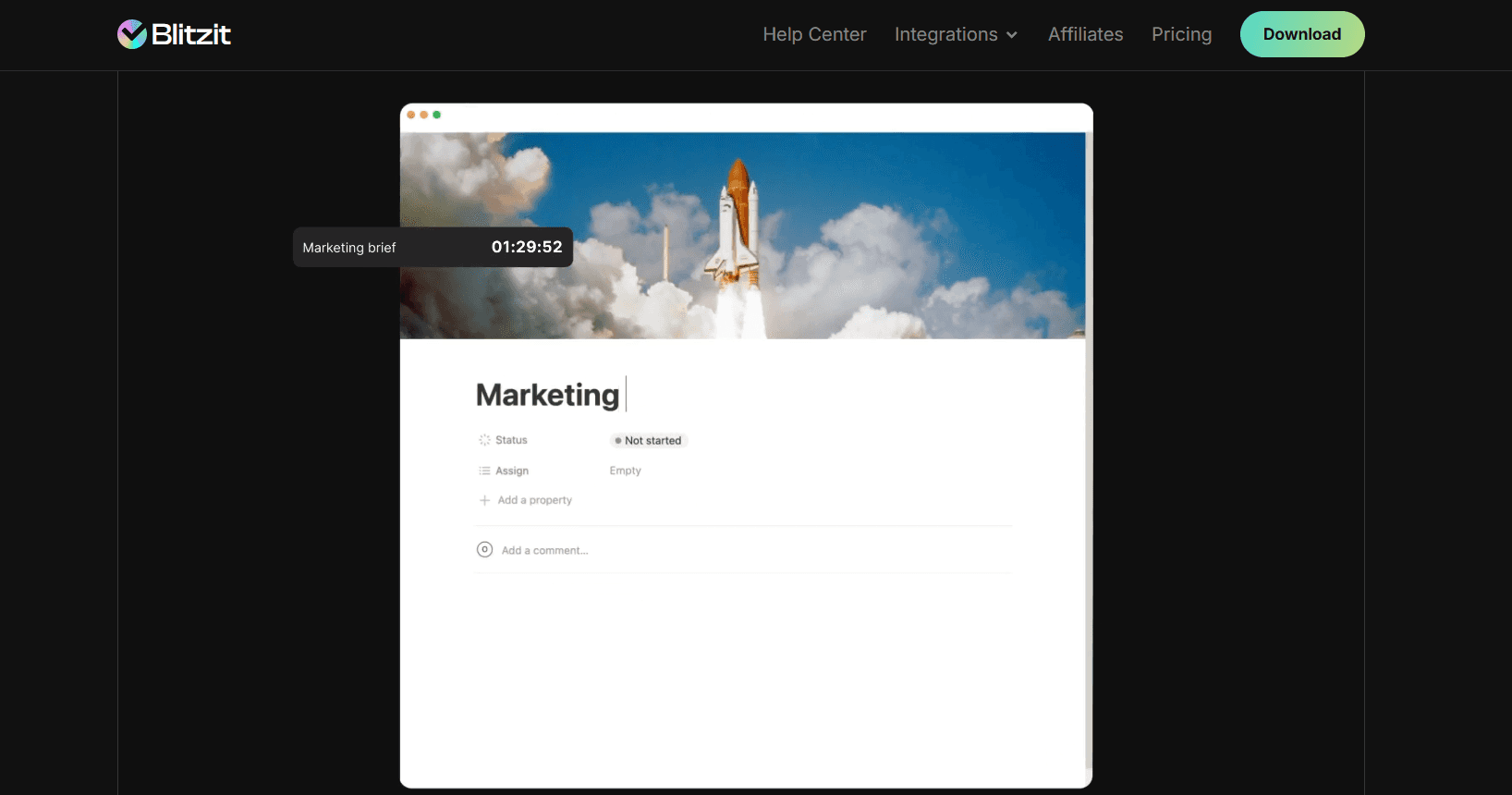
Focus Panel

The Psychology Behind Written Commitments

Here's where things get fascinating from a neuroscience perspective. Writing down a commitment – whether digitally or on paper – activates different neural pathways than simply thinking about it. The physical act of recording a plan strengthens the encoding process in your hippocampus, the brain's memory center.

Research from Dominican University found that people who wrote down their goals were significantly more likely to achieve them than those who just formulated goals mentally. But it goes deeper than achievement rates. Written commitments create what psychologists call "implementation intentions" – specific if-then scenarios that prime your brain for action.

When you write "Review project proposal at 10 AM," you're not just making a note. You're creating a mental trigger. Come 10 AM, your brain recognizes the cue and shifts into the predetermined mode. It's like setting up dominoes – once you tip the first one, the rest follow .

Building Focus Through Prioritization

Focus isn't about working harder: it's about working on the right things. And that's where most productivity efforts fail – we optimize for efficiency without first establishing effectiveness.

Your brain can only maintain deep focus for about 90-120 minutes at a time before needing a break. Yet most people treat their attention like an unlimited resource, wondering why they feel mentally drained by lunch. A daily planner helps you treat focus as the precious commodity it is.

Identifying High-Impact Tasks

Not all tasks are created equal, but our brains struggle to differentiate importance in the moment. That routine email feels just as urgent as the strategic project when they're both vying for attention.

The magic happens when you identify high-impact tasks during your planning session – before the chaos of the day begins. In Blitzit, this happens through the column system: Backlog, This Week, and Today. By physically moving tasks into the Today column in priority order, you're making importance decisions with a clear head, not in the heat of the moment.
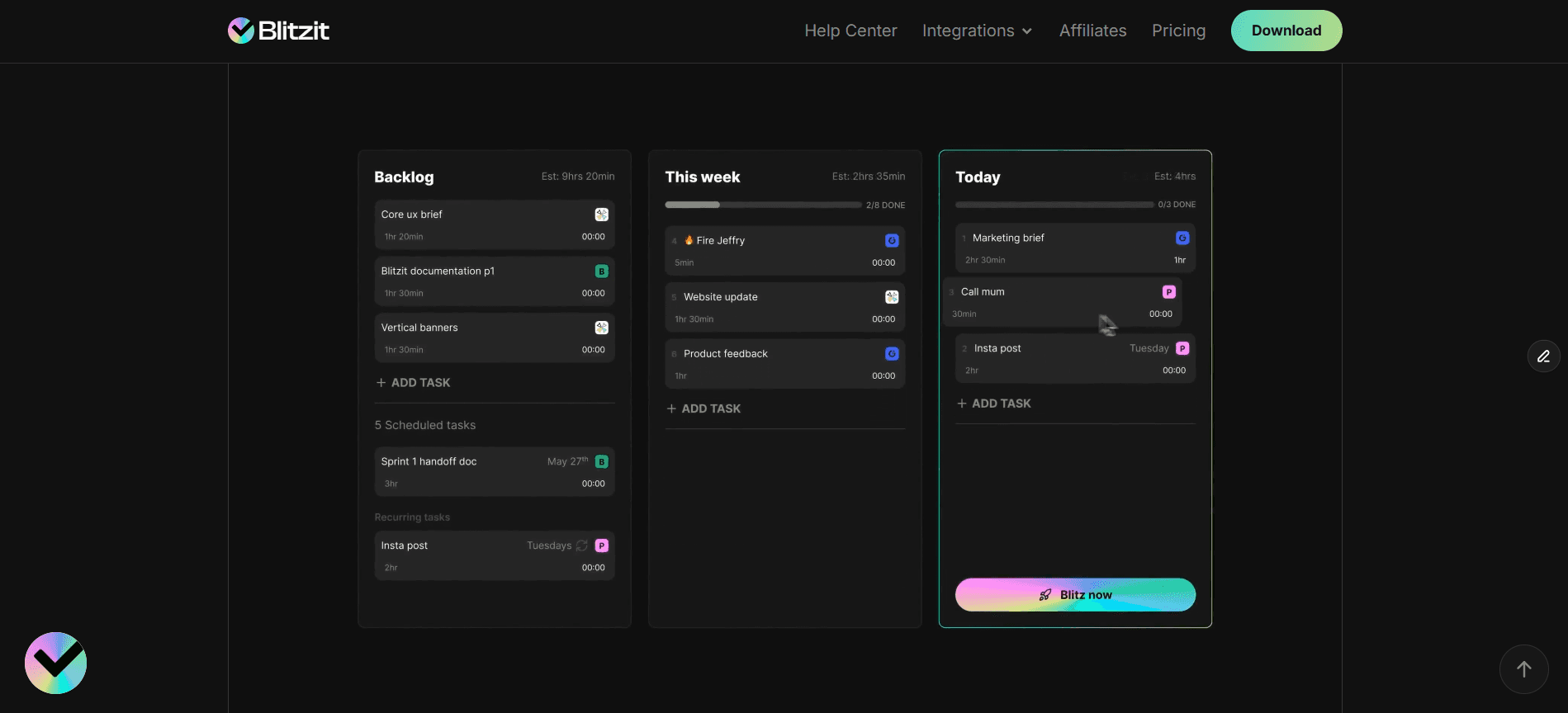
Blitzit column system

High-impact tasks usually share certain characteristics: they move major projects forward, they can't be delegated, they align with your core goals, or they have significant downstream effects. When you identify these during planning, you can protect your peak energy hours for work that matters.

Eliminating Decision Fatigue

Your brain makes roughly 35,000 decisions per day. By noon, you've already decided what to wear, what to eat, which email to answer first, whether to take that call, how to respond to that Slack message.. and the list goes on.

Each decision depletes your mental reserves. Researchers call this "decision fatigue," and it's why you can make brilliant strategic decisions at 9 AM but struggle to choose what to have for dinner. Your decision-making capacity is finite – roughly 2-3 hours of high-quality decisions per day.

A daily planner eliminates hundreds of micro-decisions. Instead of constantly asking "What should I work on next?" you've already decided. The plan is made. You just execute. This isn't restrictive – it's liberating. You're free to direct your mental energy toward the work itself, not endless deliberation about what work to do.

Creating Boundaries Between Tasks

Context switching is productivity poison. Research from the University of California, Irvine found it takes an average of 23 minutes to fully refocus after an interruption. Yet most people switch between tasks every few minutes.

Boundaries aren't limitations – they're containers that allow deep work to flourish. When you allocate specific time blocks to specific tasks, you give your brain permission to go deep. There's no guilt about not checking email because email has its own designated time.

Blitzit's timer system enforces these boundaries . When you're in focus mode with a task timer running, that floating countdown becomes your boundary guardian. It's a visual reminder that this time is spoken for, that this moment belongs to this specific task.

Transforming Overwhelm Into Organized Action

Overwhelm isn't about having too much to do – it's about not knowing how to approach what you have to do. Your brain perceives an undifferentiated mass of responsibilities as a threat, triggering stress responses that ironically make it harder to take action.

A daily planner transforms that shapeless mass into a series of concrete, manageable steps. Suddenly, "launch the new website" becomes "review homepage copy," "approve design mockups," and "test contact forms." The mountain becomes a staircase.

Breaking Down Complex Projects

The human brain struggles with abstract, large-scale planning. We're wired for immediate, concrete action. That's why a project like "write the quarterly report" feels paralyzing, but "outline section one" feels doable.

Effective planners don't just list projects – they decompose them. In Blitzit, this happens through the subtask feature. You can break any task into smaller milestones, creating a visual progress tracker that makes large tasks feel less overwhelming. Each checked subtask releases a small hit of dopamine, building momentum for the next step.

The key is making each broken-down piece specific and actionable. Not "work on presentation" but "create slides 1-5 with market analysis data." Your brain needs clear win conditions. Vague tasks create anxiety: specific tasks create clarity.

Managing Multiple Deadlines Effectively

Juggling multiple deadlines without a system is like playing three-dimensional chess in your head. You're constantly recalculating priorities, worried you're forgetting something important.

A planner externalizes this complexity. Instead of maintaining a mental model of all your deadlines, you see them laid out visually. Blitzit's scheduling feature lets you set recurring tasks for regular deadlines while keeping one-off projects organized in their respective lists.

But effective deadline management isn't just about tracking due dates. It's about backward planning – identifying the steps needed to meet each deadline and scheduling them appropriately. If the report is due Friday, when do you need the data? When does the first draft need to be complete? A good planner helps you think in terms of dependencies and sequences, not just endpoints.

Maximizing Your Productive Hours

Your energy isn't constant throughout the day – it follows predictable patterns based on your circadian rhythms, chronotype, and lifestyle factors. Yet most people plan their days as if every hour offers equal potential.

Research in chronobiology shows that aligning tasks with natural energy rhythms can increase productivity by up to 300%. That's not a marginal gain – it's a complete transformation of what's possible in a workday.

Aligning Tasks With Energy Levels

Most people experience peak cognitive performance 2-4 hours after waking, with a secondary peak in the late afternoon. But individual variations are significant. You might be sharpest at 6 AM or hit your stride at 10 PM.

Blitzit's productivity reports reveal these patterns through data. The "Most Productive Hour" metric shows when you're in focus mode the most, not when you think you should be productive. This data-driven insight lets you schedule deep work during your biological prime time.

Low-energy periods aren't wasted time – they're perfect for routine tasks that don't require peak performance. Email, administrative work, and casual meetings can fill these valleys, preserving your peaks for work that demands your best thinking.

Strategic Time Blocking Techniques

Time blocking isn't just scheduling – it's about creating themed periods where similar activities cluster together. This minimizes context switching while maximizing the compound effect of sustained focus.

The most effective approach combines fixed blocks for recurring activities with flexible blocks for project work. Maybe 9-11 AM is always deep work, 11-12 is email and communication, and afternoons vary based on priorities. This creates rhythm without rigidity.

In Blitzit, you can achieve this through strategic list organization. Create lists for different types of work – creative projects, administrative tasks, client work – and batch similar tasks together. The visual separation helps your brain prepare for the type of thinking required.

Tracking Progress And Building Momentum

Progress is the fuel of motivation. When you can see movement toward your goals, even small steps, you're more likely to keep going. A daily planner transforms invisible progress into visible wins.

Without tracking, you might work hard all day yet feel like you accomplished nothing. That's because your brain has recency bias – it remembers the unfinished tasks more vividly than the completed ones. A planner creates an objective record of your achievements.

Creating Accountability Through Documentation

Documentation isn't about surveillance – it's about self-awareness. When you track what you do versus what you planned to do, patterns emerge. Maybe you consistently underestimate certain types of tasks. Perhaps meetings always run over. Or you might discover you're most likely to skip tasks scheduled after 3 PM.

Blitzit's productivity reports turn this documentation into insights. The punctuality graph shows how often you finish tasks early versus late, helping you calibrate your time estimates. The daily productivity graph reveals your work patterns over time, showing when you're consistent and when you struggle.

This data creates natural accountability. Not the shame-based kind, but the awareness that leads to improvement. When you see that you average 45 minutes on tasks you estimated at 30, you can adjust accordingly.

Celebrating Small Wins Daily

Your brain's reward system doesn't distinguish between big and small accomplishments – it just recognizes completion. Every checked task releases dopamine, reinforcing the behavior that led to that completion.

Daily planners create opportunities for these micro-celebrations. In Blitzit, watching tasks move to the "Done" section provides visual confirmation of progress. The early streak metric celebrates when you finish all planned tasks ahead of schedule. These aren't just feel-good features – they're neurological reinforcement mechanisms.

The key is making wins visible and immediate. Don't wait until the project is completely finished to acknowledge progress. Celebrate the completed research phase, the finished first draft, the successful client call. These small wins compound into sustained motivation.

Choosing The Right Planning System For Your Needs

Not all planning systems are created equal, and the best system for you depends on your work style, environment, and specific challenges. The perfect planner for a creative freelancer might frustrate a corporate project manager.

The key is finding a system that reduces friction rather than adding it. If updating your planner feels like another chore, you won't stick with it. The right system should feel like a natural extension of your workflow.

Digital Versus Paper Planning Methods

The paper versus digital debate isn't really about which is objectively better – it's about which works better for your brain and lifestyle.

Paper planners offer tactile satisfaction and zero distractions. The physical act of writing engages different neural pathways than typing, potentially improving retention. paper calendar users are more likely to complete tasks on time compared to mobile calendar users. There's also something psychologically satisfying about physically crossing off a completed task.

Digital planners like Blitzit offer advantages paper can't match: automatic time tracking, productivity analytics, instant reorganization, and seamless integration with your digital workflow. You can't lose a digital planner or forget it at home. Cloud sync means your plans are always accessible.

Hybrid approaches work too. Maybe you sketch out weekly plans on paper for the big-picture thinking, then transfer them to a digital system for daily execution and tracking.

Essential Features To Look For

Regardless of format, certain features separate effective planners from glorified to-do lists.

  • Prioritization capabilities. You need a way to distinguish between urgent and important, between nice-to-have and must-do. Blitzit's column system handles this – tasks flow from Backlog to This Week to Today based on priority.

  • Time awareness. A task without a time estimate is a wish, not a plan. Whether through time blocking, duration estimates, or actual timers, your planner should help you understand the temporal cost of your commitments.

  • Progress visibility. You need to see both what's ahead and what's behind. Completed task archives, productivity metrics, and streak tracking transform planning from a daily restart to a continuous journey.

Finally, flexibility within structure. Your planner should provide enough structure to guide your day but enough flexibility to adapt when priorities shift. Blitzit achieves this through features like the rocket icon for instantly prioritizing tasks and easy drag-and-drop reorganization.

Conclusion

A daily planner isn't just a productivity tool – it's a cognitive partnership between your present and future self. By offloading the mental overhead of tracking, prioritizing, and deciding, you free your brain to do what it does best: think, create, and solve problems.

The transformation doesn't happen overnight. But as you build the planning habit, something shifts. The constant anxiety about forgetting something important fades. The paralysis of overwhelming task lists disappears. You start working with your natural energy rhythms instead of against them.

Most importantly, you move from reactive to proactive. Instead of letting the day happen to you, you happen to the day. Your planner becomes the bridge between intention and action, between what you want to accomplish and accomplishing it.

Whether you choose a simple notebook or a sophisticated tool like Blitzit, the core principle remains: Give your brain a system it can trust, and it will reward you with focus, clarity, and measurable progress toward your goals.

Modern work feels productive on the surface, but underneath it’s fractured. The average knowledge worker checks email every six minutes and switches tasks hundreds of times a day. Attention is constantly pulled apart, and real progress becomes harder to sustain.

High performers don’t escape this chaos by working longer hours or relying on willpower. They use systems. Studies show that people who use daily planners are 42% more likely to achieve their goals, not because they’re more disciplined, but because planning gives the brain what it needs: clarity, structure, and a clear next action.

A daily planner isn’t about doing more. It’s about turning scattered effort into deliberate progress. If you’re evaluating whether a tool like Blitzit can meaningfully change how you work, it helps to understand exactly how planning reshapes productivity from the ground up.

Understanding The Role Of Daily Planners In Time Management

A daily planner acts as your external brain – the command center where all your commitments, deadlines, and aspirations live in one place. Instead of juggling mental sticky notes that inevitably fall through the cracks, you create a single source of truth for your day.

Think about it: without a planner, you're essentially running a complex operation entirely from memory. You're tracking project deadlines, remembering that client call at 2 PM, keeping tabs on your workout schedule, and somehow trying to squeeze in deep work. Your brain wasn't designed for this level of information management.

How Planning Creates Structure In Your Day

Structure isn't about rigidity – it's about creating a framework that supports your goals. When you map out your day in advance, you're essentially building guardrails that keep you moving in the right direction.

Without structure, tasks expand to fill available time. That email that should take five minutes somehow becomes a 30-minute rabbit hole. The quick project review turns into an afternoon of scattered work. A planner creates natural boundaries. You allocate 30 minutes for email, and when that timer hits, you move on.

Blitzit's approach takes this further with its Focus Panel, which displays your day's tasks in priority order. Your top task automatically goes live with a timer, creating instant structure and momentum. No more staring at a massive to-do list wondering where to start.

Focus Panel

The Psychology Behind Written Commitments

Here's where things get fascinating from a neuroscience perspective. Writing down a commitment – whether digitally or on paper – activates different neural pathways than simply thinking about it. The physical act of recording a plan strengthens the encoding process in your hippocampus, the brain's memory center.

Research from Dominican University found that people who wrote down their goals were significantly more likely to achieve them than those who just formulated goals mentally. But it goes deeper than achievement rates. Written commitments create what psychologists call "implementation intentions" – specific if-then scenarios that prime your brain for action.

When you write "Review project proposal at 10 AM," you're not just making a note. You're creating a mental trigger. Come 10 AM, your brain recognizes the cue and shifts into the predetermined mode. It's like setting up dominoes – once you tip the first one, the rest follow .

Building Focus Through Prioritization

Focus isn't about working harder: it's about working on the right things. And that's where most productivity efforts fail – we optimize for efficiency without first establishing effectiveness.

Your brain can only maintain deep focus for about 90-120 minutes at a time before needing a break. Yet most people treat their attention like an unlimited resource, wondering why they feel mentally drained by lunch. A daily planner helps you treat focus as the precious commodity it is.

Identifying High-Impact Tasks

Not all tasks are created equal, but our brains struggle to differentiate importance in the moment. That routine email feels just as urgent as the strategic project when they're both vying for attention.

The magic happens when you identify high-impact tasks during your planning session – before the chaos of the day begins. In Blitzit, this happens through the column system: Backlog, This Week, and Today. By physically moving tasks into the Today column in priority order, you're making importance decisions with a clear head, not in the heat of the moment.

Blitzit column system

High-impact tasks usually share certain characteristics: they move major projects forward, they can't be delegated, they align with your core goals, or they have significant downstream effects. When you identify these during planning, you can protect your peak energy hours for work that matters.

Eliminating Decision Fatigue

Your brain makes roughly 35,000 decisions per day. By noon, you've already decided what to wear, what to eat, which email to answer first, whether to take that call, how to respond to that Slack message.. and the list goes on.

Each decision depletes your mental reserves. Researchers call this "decision fatigue," and it's why you can make brilliant strategic decisions at 9 AM but struggle to choose what to have for dinner. Your decision-making capacity is finite – roughly 2-3 hours of high-quality decisions per day.

A daily planner eliminates hundreds of micro-decisions. Instead of constantly asking "What should I work on next?" you've already decided. The plan is made. You just execute. This isn't restrictive – it's liberating. You're free to direct your mental energy toward the work itself, not endless deliberation about what work to do.

Creating Boundaries Between Tasks

Context switching is productivity poison. Research from the University of California, Irvine found it takes an average of 23 minutes to fully refocus after an interruption. Yet most people switch between tasks every few minutes.

Boundaries aren't limitations – they're containers that allow deep work to flourish. When you allocate specific time blocks to specific tasks, you give your brain permission to go deep. There's no guilt about not checking email because email has its own designated time.

Blitzit's timer system enforces these boundaries . When you're in focus mode with a task timer running, that floating countdown becomes your boundary guardian. It's a visual reminder that this time is spoken for, that this moment belongs to this specific task.

Transforming Overwhelm Into Organized Action

Overwhelm isn't about having too much to do – it's about not knowing how to approach what you have to do. Your brain perceives an undifferentiated mass of responsibilities as a threat, triggering stress responses that ironically make it harder to take action.

A daily planner transforms that shapeless mass into a series of concrete, manageable steps. Suddenly, "launch the new website" becomes "review homepage copy," "approve design mockups," and "test contact forms." The mountain becomes a staircase.

Breaking Down Complex Projects

The human brain struggles with abstract, large-scale planning. We're wired for immediate, concrete action. That's why a project like "write the quarterly report" feels paralyzing, but "outline section one" feels doable.

Effective planners don't just list projects – they decompose them. In Blitzit, this happens through the subtask feature. You can break any task into smaller milestones, creating a visual progress tracker that makes large tasks feel less overwhelming. Each checked subtask releases a small hit of dopamine, building momentum for the next step.

The key is making each broken-down piece specific and actionable. Not "work on presentation" but "create slides 1-5 with market analysis data." Your brain needs clear win conditions. Vague tasks create anxiety: specific tasks create clarity.

Managing Multiple Deadlines Effectively

Juggling multiple deadlines without a system is like playing three-dimensional chess in your head. You're constantly recalculating priorities, worried you're forgetting something important.

A planner externalizes this complexity. Instead of maintaining a mental model of all your deadlines, you see them laid out visually. Blitzit's scheduling feature lets you set recurring tasks for regular deadlines while keeping one-off projects organized in their respective lists.

But effective deadline management isn't just about tracking due dates. It's about backward planning – identifying the steps needed to meet each deadline and scheduling them appropriately. If the report is due Friday, when do you need the data? When does the first draft need to be complete? A good planner helps you think in terms of dependencies and sequences, not just endpoints.

Maximizing Your Productive Hours

Your energy isn't constant throughout the day – it follows predictable patterns based on your circadian rhythms, chronotype, and lifestyle factors. Yet most people plan their days as if every hour offers equal potential.

Research in chronobiology shows that aligning tasks with natural energy rhythms can increase productivity by up to 300%. That's not a marginal gain – it's a complete transformation of what's possible in a workday.

Aligning Tasks With Energy Levels

Most people experience peak cognitive performance 2-4 hours after waking, with a secondary peak in the late afternoon. But individual variations are significant. You might be sharpest at 6 AM or hit your stride at 10 PM.

Blitzit's productivity reports reveal these patterns through data. The "Most Productive Hour" metric shows when you're in focus mode the most, not when you think you should be productive. This data-driven insight lets you schedule deep work during your biological prime time.

Low-energy periods aren't wasted time – they're perfect for routine tasks that don't require peak performance. Email, administrative work, and casual meetings can fill these valleys, preserving your peaks for work that demands your best thinking.

Strategic Time Blocking Techniques

Time blocking isn't just scheduling – it's about creating themed periods where similar activities cluster together. This minimizes context switching while maximizing the compound effect of sustained focus.

The most effective approach combines fixed blocks for recurring activities with flexible blocks for project work. Maybe 9-11 AM is always deep work, 11-12 is email and communication, and afternoons vary based on priorities. This creates rhythm without rigidity.

In Blitzit, you can achieve this through strategic list organization. Create lists for different types of work – creative projects, administrative tasks, client work – and batch similar tasks together. The visual separation helps your brain prepare for the type of thinking required.

Tracking Progress And Building Momentum

Progress is the fuel of motivation. When you can see movement toward your goals, even small steps, you're more likely to keep going. A daily planner transforms invisible progress into visible wins.

Without tracking, you might work hard all day yet feel like you accomplished nothing. That's because your brain has recency bias – it remembers the unfinished tasks more vividly than the completed ones. A planner creates an objective record of your achievements.

Creating Accountability Through Documentation

Documentation isn't about surveillance – it's about self-awareness. When you track what you do versus what you planned to do, patterns emerge. Maybe you consistently underestimate certain types of tasks. Perhaps meetings always run over. Or you might discover you're most likely to skip tasks scheduled after 3 PM.

Blitzit's productivity reports turn this documentation into insights. The punctuality graph shows how often you finish tasks early versus late, helping you calibrate your time estimates. The daily productivity graph reveals your work patterns over time, showing when you're consistent and when you struggle.

This data creates natural accountability. Not the shame-based kind, but the awareness that leads to improvement. When you see that you average 45 minutes on tasks you estimated at 30, you can adjust accordingly.

Celebrating Small Wins Daily

Your brain's reward system doesn't distinguish between big and small accomplishments – it just recognizes completion. Every checked task releases dopamine, reinforcing the behavior that led to that completion.

Daily planners create opportunities for these micro-celebrations. In Blitzit, watching tasks move to the "Done" section provides visual confirmation of progress. The early streak metric celebrates when you finish all planned tasks ahead of schedule. These aren't just feel-good features – they're neurological reinforcement mechanisms.

The key is making wins visible and immediate. Don't wait until the project is completely finished to acknowledge progress. Celebrate the completed research phase, the finished first draft, the successful client call. These small wins compound into sustained motivation.

Choosing The Right Planning System For Your Needs

Not all planning systems are created equal, and the best system for you depends on your work style, environment, and specific challenges. The perfect planner for a creative freelancer might frustrate a corporate project manager.

The key is finding a system that reduces friction rather than adding it. If updating your planner feels like another chore, you won't stick with it. The right system should feel like a natural extension of your workflow.

Digital Versus Paper Planning Methods

The paper versus digital debate isn't really about which is objectively better – it's about which works better for your brain and lifestyle.

Paper planners offer tactile satisfaction and zero distractions. The physical act of writing engages different neural pathways than typing, potentially improving retention. paper calendar users are more likely to complete tasks on time compared to mobile calendar users. There's also something psychologically satisfying about physically crossing off a completed task.

Digital planners like Blitzit offer advantages paper can't match: automatic time tracking, productivity analytics, instant reorganization, and seamless integration with your digital workflow. You can't lose a digital planner or forget it at home. Cloud sync means your plans are always accessible.

Hybrid approaches work too. Maybe you sketch out weekly plans on paper for the big-picture thinking, then transfer them to a digital system for daily execution and tracking.

Essential Features To Look For

Regardless of format, certain features separate effective planners from glorified to-do lists.

  • Prioritization capabilities. You need a way to distinguish between urgent and important, between nice-to-have and must-do. Blitzit's column system handles this – tasks flow from Backlog to This Week to Today based on priority.

  • Time awareness. A task without a time estimate is a wish, not a plan. Whether through time blocking, duration estimates, or actual timers, your planner should help you understand the temporal cost of your commitments.

  • Progress visibility. You need to see both what's ahead and what's behind. Completed task archives, productivity metrics, and streak tracking transform planning from a daily restart to a continuous journey.

Finally, flexibility within structure. Your planner should provide enough structure to guide your day but enough flexibility to adapt when priorities shift. Blitzit achieves this through features like the rocket icon for instantly prioritizing tasks and easy drag-and-drop reorganization.

Conclusion

A daily planner isn't just a productivity tool – it's a cognitive partnership between your present and future self. By offloading the mental overhead of tracking, prioritizing, and deciding, you free your brain to do what it does best: think, create, and solve problems.

The transformation doesn't happen overnight. But as you build the planning habit, something shifts. The constant anxiety about forgetting something important fades. The paralysis of overwhelming task lists disappears. You start working with your natural energy rhythms instead of against them.

Most importantly, you move from reactive to proactive. Instead of letting the day happen to you, you happen to the day. Your planner becomes the bridge between intention and action, between what you want to accomplish and accomplishing it.

Whether you choose a simple notebook or a sophisticated tool like Blitzit, the core principle remains: Give your brain a system it can trust, and it will reward you with focus, clarity, and measurable progress toward your goals.

Modern work feels productive on the surface, but underneath it’s fractured. The average knowledge worker checks email every six minutes and switches tasks hundreds of times a day. Attention is constantly pulled apart, and real progress becomes harder to sustain.

High performers don’t escape this chaos by working longer hours or relying on willpower. They use systems. Studies show that people who use daily planners are 42% more likely to achieve their goals, not because they’re more disciplined, but because planning gives the brain what it needs: clarity, structure, and a clear next action.

A daily planner isn’t about doing more. It’s about turning scattered effort into deliberate progress. If you’re evaluating whether a tool like Blitzit can meaningfully change how you work, it helps to understand exactly how planning reshapes productivity from the ground up.

Understanding The Role Of Daily Planners In Time Management

A daily planner acts as your external brain – the command center where all your commitments, deadlines, and aspirations live in one place. Instead of juggling mental sticky notes that inevitably fall through the cracks, you create a single source of truth for your day.

Think about it: without a planner, you're essentially running a complex operation entirely from memory. You're tracking project deadlines, remembering that client call at 2 PM, keeping tabs on your workout schedule, and somehow trying to squeeze in deep work. Your brain wasn't designed for this level of information management.

How Planning Creates Structure In Your Day

Structure isn't about rigidity – it's about creating a framework that supports your goals. When you map out your day in advance, you're essentially building guardrails that keep you moving in the right direction.

Without structure, tasks expand to fill available time. That email that should take five minutes somehow becomes a 30-minute rabbit hole. The quick project review turns into an afternoon of scattered work. A planner creates natural boundaries. You allocate 30 minutes for email, and when that timer hits, you move on.

Blitzit's approach takes this further with its Focus Panel, which displays your day's tasks in priority order. Your top task automatically goes live with a timer, creating instant structure and momentum. No more staring at a massive to-do list wondering where to start.

Focus Panel

The Psychology Behind Written Commitments

Here's where things get fascinating from a neuroscience perspective. Writing down a commitment – whether digitally or on paper – activates different neural pathways than simply thinking about it. The physical act of recording a plan strengthens the encoding process in your hippocampus, the brain's memory center.

Research from Dominican University found that people who wrote down their goals were significantly more likely to achieve them than those who just formulated goals mentally. But it goes deeper than achievement rates. Written commitments create what psychologists call "implementation intentions" – specific if-then scenarios that prime your brain for action.

When you write "Review project proposal at 10 AM," you're not just making a note. You're creating a mental trigger. Come 10 AM, your brain recognizes the cue and shifts into the predetermined mode. It's like setting up dominoes – once you tip the first one, the rest follow .

Building Focus Through Prioritization

Focus isn't about working harder: it's about working on the right things. And that's where most productivity efforts fail – we optimize for efficiency without first establishing effectiveness.

Your brain can only maintain deep focus for about 90-120 minutes at a time before needing a break. Yet most people treat their attention like an unlimited resource, wondering why they feel mentally drained by lunch. A daily planner helps you treat focus as the precious commodity it is.

Identifying High-Impact Tasks

Not all tasks are created equal, but our brains struggle to differentiate importance in the moment. That routine email feels just as urgent as the strategic project when they're both vying for attention.

The magic happens when you identify high-impact tasks during your planning session – before the chaos of the day begins. In Blitzit, this happens through the column system: Backlog, This Week, and Today. By physically moving tasks into the Today column in priority order, you're making importance decisions with a clear head, not in the heat of the moment.

Blitzit column system

High-impact tasks usually share certain characteristics: they move major projects forward, they can't be delegated, they align with your core goals, or they have significant downstream effects. When you identify these during planning, you can protect your peak energy hours for work that matters.

Eliminating Decision Fatigue

Your brain makes roughly 35,000 decisions per day. By noon, you've already decided what to wear, what to eat, which email to answer first, whether to take that call, how to respond to that Slack message.. and the list goes on.

Each decision depletes your mental reserves. Researchers call this "decision fatigue," and it's why you can make brilliant strategic decisions at 9 AM but struggle to choose what to have for dinner. Your decision-making capacity is finite – roughly 2-3 hours of high-quality decisions per day.

A daily planner eliminates hundreds of micro-decisions. Instead of constantly asking "What should I work on next?" you've already decided. The plan is made. You just execute. This isn't restrictive – it's liberating. You're free to direct your mental energy toward the work itself, not endless deliberation about what work to do.

Creating Boundaries Between Tasks

Context switching is productivity poison. Research from the University of California, Irvine found it takes an average of 23 minutes to fully refocus after an interruption. Yet most people switch between tasks every few minutes.

Boundaries aren't limitations – they're containers that allow deep work to flourish. When you allocate specific time blocks to specific tasks, you give your brain permission to go deep. There's no guilt about not checking email because email has its own designated time.

Blitzit's timer system enforces these boundaries . When you're in focus mode with a task timer running, that floating countdown becomes your boundary guardian. It's a visual reminder that this time is spoken for, that this moment belongs to this specific task.

Transforming Overwhelm Into Organized Action

Overwhelm isn't about having too much to do – it's about not knowing how to approach what you have to do. Your brain perceives an undifferentiated mass of responsibilities as a threat, triggering stress responses that ironically make it harder to take action.

A daily planner transforms that shapeless mass into a series of concrete, manageable steps. Suddenly, "launch the new website" becomes "review homepage copy," "approve design mockups," and "test contact forms." The mountain becomes a staircase.

Breaking Down Complex Projects

The human brain struggles with abstract, large-scale planning. We're wired for immediate, concrete action. That's why a project like "write the quarterly report" feels paralyzing, but "outline section one" feels doable.

Effective planners don't just list projects – they decompose them. In Blitzit, this happens through the subtask feature. You can break any task into smaller milestones, creating a visual progress tracker that makes large tasks feel less overwhelming. Each checked subtask releases a small hit of dopamine, building momentum for the next step.

The key is making each broken-down piece specific and actionable. Not "work on presentation" but "create slides 1-5 with market analysis data." Your brain needs clear win conditions. Vague tasks create anxiety: specific tasks create clarity.

Managing Multiple Deadlines Effectively

Juggling multiple deadlines without a system is like playing three-dimensional chess in your head. You're constantly recalculating priorities, worried you're forgetting something important.

A planner externalizes this complexity. Instead of maintaining a mental model of all your deadlines, you see them laid out visually. Blitzit's scheduling feature lets you set recurring tasks for regular deadlines while keeping one-off projects organized in their respective lists.

But effective deadline management isn't just about tracking due dates. It's about backward planning – identifying the steps needed to meet each deadline and scheduling them appropriately. If the report is due Friday, when do you need the data? When does the first draft need to be complete? A good planner helps you think in terms of dependencies and sequences, not just endpoints.

Maximizing Your Productive Hours

Your energy isn't constant throughout the day – it follows predictable patterns based on your circadian rhythms, chronotype, and lifestyle factors. Yet most people plan their days as if every hour offers equal potential.

Research in chronobiology shows that aligning tasks with natural energy rhythms can increase productivity by up to 300%. That's not a marginal gain – it's a complete transformation of what's possible in a workday.

Aligning Tasks With Energy Levels

Most people experience peak cognitive performance 2-4 hours after waking, with a secondary peak in the late afternoon. But individual variations are significant. You might be sharpest at 6 AM or hit your stride at 10 PM.

Blitzit's productivity reports reveal these patterns through data. The "Most Productive Hour" metric shows when you're in focus mode the most, not when you think you should be productive. This data-driven insight lets you schedule deep work during your biological prime time.

Low-energy periods aren't wasted time – they're perfect for routine tasks that don't require peak performance. Email, administrative work, and casual meetings can fill these valleys, preserving your peaks for work that demands your best thinking.

Strategic Time Blocking Techniques

Time blocking isn't just scheduling – it's about creating themed periods where similar activities cluster together. This minimizes context switching while maximizing the compound effect of sustained focus.

The most effective approach combines fixed blocks for recurring activities with flexible blocks for project work. Maybe 9-11 AM is always deep work, 11-12 is email and communication, and afternoons vary based on priorities. This creates rhythm without rigidity.

In Blitzit, you can achieve this through strategic list organization. Create lists for different types of work – creative projects, administrative tasks, client work – and batch similar tasks together. The visual separation helps your brain prepare for the type of thinking required.

Tracking Progress And Building Momentum

Progress is the fuel of motivation. When you can see movement toward your goals, even small steps, you're more likely to keep going. A daily planner transforms invisible progress into visible wins.

Without tracking, you might work hard all day yet feel like you accomplished nothing. That's because your brain has recency bias – it remembers the unfinished tasks more vividly than the completed ones. A planner creates an objective record of your achievements.

Creating Accountability Through Documentation

Documentation isn't about surveillance – it's about self-awareness. When you track what you do versus what you planned to do, patterns emerge. Maybe you consistently underestimate certain types of tasks. Perhaps meetings always run over. Or you might discover you're most likely to skip tasks scheduled after 3 PM.

Blitzit's productivity reports turn this documentation into insights. The punctuality graph shows how often you finish tasks early versus late, helping you calibrate your time estimates. The daily productivity graph reveals your work patterns over time, showing when you're consistent and when you struggle.

This data creates natural accountability. Not the shame-based kind, but the awareness that leads to improvement. When you see that you average 45 minutes on tasks you estimated at 30, you can adjust accordingly.

Celebrating Small Wins Daily

Your brain's reward system doesn't distinguish between big and small accomplishments – it just recognizes completion. Every checked task releases dopamine, reinforcing the behavior that led to that completion.

Daily planners create opportunities for these micro-celebrations. In Blitzit, watching tasks move to the "Done" section provides visual confirmation of progress. The early streak metric celebrates when you finish all planned tasks ahead of schedule. These aren't just feel-good features – they're neurological reinforcement mechanisms.

The key is making wins visible and immediate. Don't wait until the project is completely finished to acknowledge progress. Celebrate the completed research phase, the finished first draft, the successful client call. These small wins compound into sustained motivation.

Choosing The Right Planning System For Your Needs

Not all planning systems are created equal, and the best system for you depends on your work style, environment, and specific challenges. The perfect planner for a creative freelancer might frustrate a corporate project manager.

The key is finding a system that reduces friction rather than adding it. If updating your planner feels like another chore, you won't stick with it. The right system should feel like a natural extension of your workflow.

Digital Versus Paper Planning Methods

The paper versus digital debate isn't really about which is objectively better – it's about which works better for your brain and lifestyle.

Paper planners offer tactile satisfaction and zero distractions. The physical act of writing engages different neural pathways than typing, potentially improving retention. paper calendar users are more likely to complete tasks on time compared to mobile calendar users. There's also something psychologically satisfying about physically crossing off a completed task.

Digital planners like Blitzit offer advantages paper can't match: automatic time tracking, productivity analytics, instant reorganization, and seamless integration with your digital workflow. You can't lose a digital planner or forget it at home. Cloud sync means your plans are always accessible.

Hybrid approaches work too. Maybe you sketch out weekly plans on paper for the big-picture thinking, then transfer them to a digital system for daily execution and tracking.

Essential Features To Look For

Regardless of format, certain features separate effective planners from glorified to-do lists.

  • Prioritization capabilities. You need a way to distinguish between urgent and important, between nice-to-have and must-do. Blitzit's column system handles this – tasks flow from Backlog to This Week to Today based on priority.

  • Time awareness. A task without a time estimate is a wish, not a plan. Whether through time blocking, duration estimates, or actual timers, your planner should help you understand the temporal cost of your commitments.

  • Progress visibility. You need to see both what's ahead and what's behind. Completed task archives, productivity metrics, and streak tracking transform planning from a daily restart to a continuous journey.

Finally, flexibility within structure. Your planner should provide enough structure to guide your day but enough flexibility to adapt when priorities shift. Blitzit achieves this through features like the rocket icon for instantly prioritizing tasks and easy drag-and-drop reorganization.

Conclusion

A daily planner isn't just a productivity tool – it's a cognitive partnership between your present and future self. By offloading the mental overhead of tracking, prioritizing, and deciding, you free your brain to do what it does best: think, create, and solve problems.

The transformation doesn't happen overnight. But as you build the planning habit, something shifts. The constant anxiety about forgetting something important fades. The paralysis of overwhelming task lists disappears. You start working with your natural energy rhythms instead of against them.

Most importantly, you move from reactive to proactive. Instead of letting the day happen to you, you happen to the day. Your planner becomes the bridge between intention and action, between what you want to accomplish and accomplishing it.

Whether you choose a simple notebook or a sophisticated tool like Blitzit, the core principle remains: Give your brain a system it can trust, and it will reward you with focus, clarity, and measurable progress toward your goals.