

Proven Time Management Methods

5 Proven Time Management Methods That Actually Work

5 Proven Time Management Methods That Actually Work

5 Proven Time Management Methods That Actually Work

Written by

Blitzit Team

Published

Jan 26, 2026

Most people move through their workday feeling one step behind, reacting to tasks instead of controlling them. In fact, only 37% of people feel truly in control of their workload on any given day. That constant sense of urgency creates stress, scattered focus, and unfinished priorities. Over time, it makes productivity feel exhausting instead of effective.

True time management isn’t about cramming more into your schedule, it’s about using smarter, proven methods to focus on what actually matters. The right approach helps you prioritize with intention, reduce mental overload, and make steady progress without burnout. Whether you’re balancing multiple projects, fighting distractions, or refining your workflow, a solid time management system can change how you work. And when paired with the right tools, it becomes even more powerful.

Understanding The Importance of Time Management

Importance of Time Management

Time management isn't just corporate buzzword bingo, research shows it has a moderate but significant correlation with job performance, acadec success, and overall wellbeing. When you manage your time effectively, you're essentially taking control of your workload rather than letting it control you.

The numbers tell an interesting story. Even though the abundance of productivity advice out there, most of us are still struggling. With only 37% of people feeling in control daily, there's a gap between knowing what to do and doing it. That's where structured time management methods come in.

Think of time management methods as frameworks for decision-making. They help you answer critical questions: What should I work on first? How long should I spend on this task? When should I take a break? Without these frameworks, you're left making dozens of micro-decisions throughout the day, which leads to decision fatigue and, ironically, wasted time.

The beauty of proven time management methods is they've already been battle-tested by millions of professionals. You don't have to reinvent the wheel, you just need to find the right wheel for your particular journey.

  1. The Eisenhower Matrix Method

Named after President Dwight D. Eisenhower, this method is deceptively simple yet incredibly powerful. At its core, the Eisenhower Matrix helps you distinguish between what's urgent and what's important, two concepts that we often confuse in the heat of daily work.

Here's the fascinating part: while only about 1% of people formally use the Eisenhower Matrix, research shows that 92% of us unconsciously use elements of it when prioritizing tasks. We understand that some things matter more than others. The matrix just gives us a systematic way to apply that understanding.

The method divides all your tasks into four quadrants based on urgency and importance. This creates a clear hierarchy that removes the guesswork from prioritization. Instead of responding to whatever feels most pressing in the moment, you're making strategic decisions about where to invest your energy.

How To Categorize Tasks By Urgency And Importance

Picture a simple 2x2 grid. The vertical axis represents importance (how much this task contributes to your goals), while the horizontal axis represents urgency (how time-sensitive it is). This creates four distinct categories:

  • Quadrant 1 (Urgent & Important): These are your crisis tasks, the presentation due tomorrow, the server that just crashed, the client emergency. Do these immediately.

  • Quadrant 2 (Important but Not Urgent): This is where the magic happens. Strategic planning, relationship building, skill development, these tasks don't scream for attention but they're crucial for long-term success. Schedule these.

  • Quadrant 3 (Urgent but Not Important): The interruptions and busywork that feel pressing but don't move the needle. Most emails fall here. Delegate when possible.

  • Quadrant 4 (Neither Urgent nor Important): Time wasters. That hour scrolling social media? Delete these from your schedule.

The real insight? Most people spend too much time in Quadrants 1 and 3, bouncing between crises and interruptions. But the highest performers live in Quadrant 2, working on important tasks before they become urgent.

  1. Time Blocking And Calendar Management

If the Eisenhower Matrix tells you what to work on, time blocking tells you when. This method transforms your calendar from a record of meetings into a proactive tool for protecting your most valuable resource: focused work time.

Time blocking is surprisingly popular, about 5% of people use it exclusively, while 23% incorporate elements of it into their workflow. The appeal is obvious: in our distraction-rich environment, if you don't deliberately protect time for important work, that time simply disappears into a black hole of meetings, emails, and "quick questions."

The principle is straightforward. You divide your workday into distinct blocks and assign specific tasks or types of work to each block. No more working on whatever feels urgent at the moment. Your calendar becomes your boss, telling you exactly what to focus on and when.

Creating Effective Time Blocks

Start with your non-negotiables. When do you have recurring meetings? When do you need to be available for your team? Block those first. Now look at what's left, this is your canvas for deep work.

Next, identify your peak energy hours. Are you a morning person who can tackle complex problems at 7 AM? Or do you hit your stride after lunch? Assign your most challenging, important work to these high-energy blocks. Save routine tasks for when your brain is running on autopilot.

Here's what a time-blocked morning might look like:

  • 9:00-10:30 AM: Deep work on project proposal (notifications off)

  • 10:30-11:00 AM: Email and quick responses

  • 11:00-11:30 AM: Team check-in

  • 11:30 AM-12:30 PM: Content creation

The key is being realistic about how long tasks take. We're terrible at estimating, usually underestimating by 20-40%. Build in buffer time between blocks. And review your blocks weekly to see what worked and what didn't.

  1. The Pomodoro Technique

In the late 1980s, a university student named Francesco Cirillo was struggling to focus on his studies. In desperation, he grabbed a tomato-shaped kitchen timer (pomodoro in Italian), set it for 10 minutes, and challenged himself to study with full concentration until it rang. That simple experiment evolved into one of the world's most popular productivity techniques.

The Pomodoro Technique works because it transforms work from a marathon into a series of sprints. Instead of facing a mountain of work with no end in sight, you're just committing to 25 minutes. That's it. Anyone can focus for 25 minutes, right?

But there's more happening here than just making work feel manageable. The technique builds in recovery time (those 5-minute breaks), tracks your productivity (how many pomodoros did you complete?), and creates a sense of urgency that combats procrastination. It's particularly effective for people who struggle with focus or tend to perfectionist tendencies, the timer creates a healthy pressure to produce rather than polish endlessly.

Setting Up Work And Break Intervals

The classic Pomodoro formula is simple: 25 minutes of focused work, 5-minute break. After four pomodoros, take a longer 30-minute break. But here's the thing, these aren't arbitrary numbers. They're based on our natural attention spans and the idea that frequent breaks improve mental agility.

To start, grab any timer. Your phone works, but a physical timer is better, there's something about that ticking sound that keeps you accountable. Set it for 25 minutes and choose ONE task to work on. Not three tasks. Not "whatever I can get done." One specific task.

When the timer rings, stop. Even if you're mid-sentence. This trains your brain that the timer is boss. During your 5-minute break, truly disconnect. Stand up, stretch, grab water. Don't check email, that's not a break, that's a task switch.

One powerful addition: keep a distraction log. When random thoughts pop up ("I should check that invoice," "What was that movie called?"), jot them down quickly and return to your task. This acknowledges the thought without derailing your focus.

  1. Getting Things Done (GTD) Methodology

David Allen's Getting Things Done methodology isn't just about productivity, it's about achieving what Allen calls "mind like water," a state where your mind is clear and ready to engage with whatever comes your way. No more lying awake at 3 AM remembering that email you forgot to send.

GTD is built on a simple premise: your brain is for having ideas, not holding them. When you try to keep track of everything mentally, you create unnecessary stress and inevitably drop balls. The solution? Get everything out of your head and into a trusted system.

What makes GTD different from other methods is its comprehensiveness. While the Eisenhower Matrix helps you prioritize and Pomodoro helps you focus, GTD provides a complete workflow for capturing, processing, and executing on everything that has your attention. It's particularly powerful for knowledge workers juggling multiple projects and responsibilities.

The Five Steps Of GTD Processing

The GTD workflow breaks down into five distinct stages, each building on the previous:

1. Capture: Everything goes into an inbox, physical or digital. Email from your boss? Into the inbox. Random idea during your commute? Inbox. Bill to pay? Inbox. The goal is to capture 100% of what has your attention.

2. Clarify: This is where you process what you've captured. For each item, ask: Is it actionable? If no, trash it, file it for reference, or add it to a someday/maybe list. If yes, what's the next action? Be specific, not "deal with presentation" but "email Susan for Q3 sales data."

3. Organize: Put each clarified item where it belongs. Next actions go on context-based lists (@computer, @phone, @office). Projects (anything requiring more than one action) get their own list. Calendar items go on your calendar.

4. Reflect: Weekly reviews keep the system alive. Review all your lists, clear your inboxes, and update your projects. This is when you catch things slipping through cracks.

5. Engage: Now you simply work from your lists, confident that they contain everything you need to do. No more wondering what you're forgetting.

The magic happens when all five steps work together. You're never wondering whether you should be doing something else because everything is captured and organized.

  1. The Two-Minute Rule And Quick Wins

Sometimes the best productivity hack is the simplest one. The Two-Minute Rule, popularized by David Allen in GTD, states: if a task takes less than two minutes to complete, do it now. Don't add it to a list. Don't schedule it. Just do it.

This rule is genius because it recognizes a fundamental truth about productivity: the overhead of managing a task often exceeds the task itself. Think about it, adding "reply to John's email" to your to-do list, reviewing it later, scheduling time for it, then finally doing it probably takes more than two minutes total. You could've just replied when you first read it.

But the Two-Minute Rule does more than save time. It creates momentum. Knocking out several quick tasks gives you a psychological boost, suddenly you're in productive mode. It's like warming up before exercise. Those quick wins prime your brain for tackling bigger challenges.

The rule also prevents task accumulation. You know that overwhelming feeling when your to-do list grows faster than you can complete it? Many of those tasks are two-minute items that could've been handled immediately. By dealing with them right away, you keep your lists manageable and your mind clear.

There's a variation of this rule that's equally powerful: start any challenging job by committing to just two minutes. Can't face that report? Just open the document and write the title. Dreading that workout? Just put on your gym clothes. Often, starting is the hardest part, and two minutes is enough to break through initial resistance.

One warning though: the Two-Minute Rule can become a procrastination tool if you're not careful. Spending all day on two-minute tasks while avoiding important work isn't productivity, it's sophisticated avoidance. Use the rule during designated processing times, not as an escape from deep work.

Choosing The Right Method For Your Work Style

Here's what nobody tells you about productivity methods: the best one is the one you'll use. You could have the most sophisticated system in the world, but if it doesn't match your work style, it's worthless.

So how do you choose? Start by understanding your natural tendencies. Are you a visual person who thinks in pictures and diagrams? The Eisenhower Matrix or Kanban boards might click for you. Do you thrive on structure and clear processes? GTD could be your match. Need external pressure to maintain focus? The Pomodoro timer might be your new best friend.

Consider your work environment too. Time blocking works brilliantly if you control your schedule, but might frustrate you in a reactive role where priorities shift hourly. The Pomodoro Technique is perfect for solo deep work but challenging in an open office with constant interruptions.

Your current pain points also matter. Struggling with prioritization? Start with the Eisenhower Matrix. Can't focus for extended periods? Try Pomodoro. Overwhelmed by everything you need to track? GTD might be the answer. Spending too much time on trivial tasks? Carry out the Two-Minute Rule.

The research shows interesting patterns: the ABC method (similar to Eisenhower Matrix priorities) ranks highest for effectiveness, yet formal adoption remains low. This suggests that simple, flexible methods often outperform complex systems. Don't overthink it.

Many successful professionals use hybrid approaches. They might time block their mornings, use Pomodoros for afternoon focus work, and apply the Two-Minute Rule during email processing. You're not married to one method, mix and match based on what works.

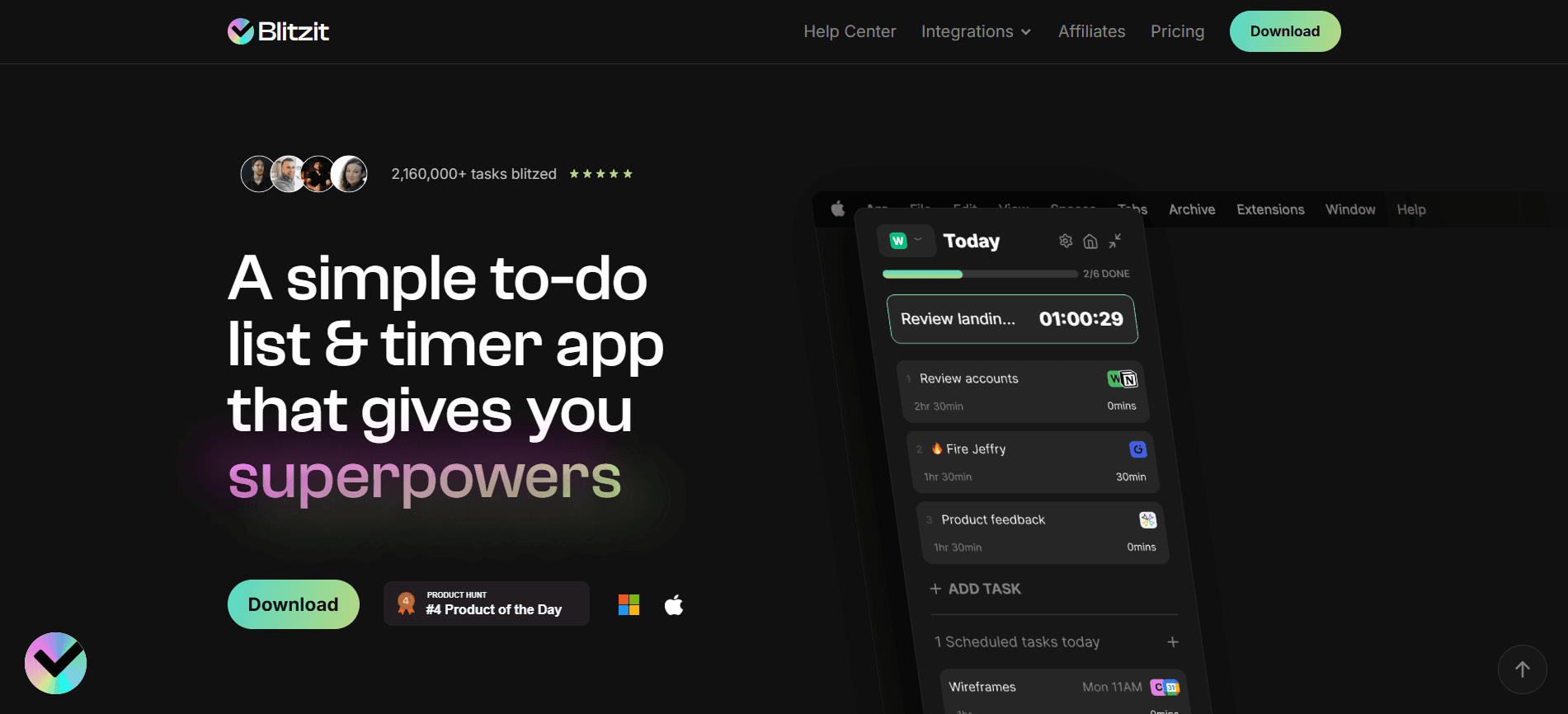
Tools like Blitzit can support multiple methods simultaneously. Its task prioritization features align with the Eisenhower Matrix, the built-in Pomodoro timer supports focused work sessions, and the task estimation features help with time blocking. The key is starting with one method, mastering it, then layering in others as needed.
Blitzit website

Remember: these methods are meant to serve you, not the other way around. If something isn't working, adjust it. The goal isn't perfection, it's progress.

Conclusion

Effective time management isn't about doing more, it's about doing what matters. Whether you gravitate toward the strategic clarity of the Eisenhower Matrix, the focused sprints of Pomodoro, or the comprehensive workflow of GTD, the key is taking action.

Start small. Pick one method that resonates with you and try it for a week. Don't aim for perfection: aim for consistency. As you build confidence, you can refine your approach or incorporate elements from other methods.

The beauty of these time management methods is they're not mutually exclusive. You might use the Eisenhower Matrix for weekly planning, time blocking for daily structure, and Pomodoro sessions for deep work. Tools like Blitzit can support this integrated approach, helping you prioritize tasks, maintain focus, and track your productivity patterns over time.

Most people move through their workday feeling one step behind, reacting to tasks instead of controlling them. In fact, only 37% of people feel truly in control of their workload on any given day. That constant sense of urgency creates stress, scattered focus, and unfinished priorities. Over time, it makes productivity feel exhausting instead of effective.

True time management isn’t about cramming more into your schedule, it’s about using smarter, proven methods to focus on what actually matters. The right approach helps you prioritize with intention, reduce mental overload, and make steady progress without burnout. Whether you’re balancing multiple projects, fighting distractions, or refining your workflow, a solid time management system can change how you work. And when paired with the right tools, it becomes even more powerful.

Understanding The Importance of Time Management

Importance of Time Management

Time management isn't just corporate buzzword bingo, research shows it has a moderate but significant correlation with job performance, acadec success, and overall wellbeing. When you manage your time effectively, you're essentially taking control of your workload rather than letting it control you.

The numbers tell an interesting story. Even though the abundance of productivity advice out there, most of us are still struggling. With only 37% of people feeling in control daily, there's a gap between knowing what to do and doing it. That's where structured time management methods come in.

Think of time management methods as frameworks for decision-making. They help you answer critical questions: What should I work on first? How long should I spend on this task? When should I take a break? Without these frameworks, you're left making dozens of micro-decisions throughout the day, which leads to decision fatigue and, ironically, wasted time.

The beauty of proven time management methods is they've already been battle-tested by millions of professionals. You don't have to reinvent the wheel, you just need to find the right wheel for your particular journey.

  1. The Eisenhower Matrix Method

Named after President Dwight D. Eisenhower, this method is deceptively simple yet incredibly powerful. At its core, the Eisenhower Matrix helps you distinguish between what's urgent and what's important, two concepts that we often confuse in the heat of daily work.

Here's the fascinating part: while only about 1% of people formally use the Eisenhower Matrix, research shows that 92% of us unconsciously use elements of it when prioritizing tasks. We understand that some things matter more than others. The matrix just gives us a systematic way to apply that understanding.

The method divides all your tasks into four quadrants based on urgency and importance. This creates a clear hierarchy that removes the guesswork from prioritization. Instead of responding to whatever feels most pressing in the moment, you're making strategic decisions about where to invest your energy.

How To Categorize Tasks By Urgency And Importance

Picture a simple 2x2 grid. The vertical axis represents importance (how much this task contributes to your goals), while the horizontal axis represents urgency (how time-sensitive it is). This creates four distinct categories:

  • Quadrant 1 (Urgent & Important): These are your crisis tasks, the presentation due tomorrow, the server that just crashed, the client emergency. Do these immediately.

  • Quadrant 2 (Important but Not Urgent): This is where the magic happens. Strategic planning, relationship building, skill development, these tasks don't scream for attention but they're crucial for long-term success. Schedule these.

  • Quadrant 3 (Urgent but Not Important): The interruptions and busywork that feel pressing but don't move the needle. Most emails fall here. Delegate when possible.

  • Quadrant 4 (Neither Urgent nor Important): Time wasters. That hour scrolling social media? Delete these from your schedule.

The real insight? Most people spend too much time in Quadrants 1 and 3, bouncing between crises and interruptions. But the highest performers live in Quadrant 2, working on important tasks before they become urgent.

  1. Time Blocking And Calendar Management

If the Eisenhower Matrix tells you what to work on, time blocking tells you when. This method transforms your calendar from a record of meetings into a proactive tool for protecting your most valuable resource: focused work time.

Time blocking is surprisingly popular, about 5% of people use it exclusively, while 23% incorporate elements of it into their workflow. The appeal is obvious: in our distraction-rich environment, if you don't deliberately protect time for important work, that time simply disappears into a black hole of meetings, emails, and "quick questions."

The principle is straightforward. You divide your workday into distinct blocks and assign specific tasks or types of work to each block. No more working on whatever feels urgent at the moment. Your calendar becomes your boss, telling you exactly what to focus on and when.

Creating Effective Time Blocks

Start with your non-negotiables. When do you have recurring meetings? When do you need to be available for your team? Block those first. Now look at what's left, this is your canvas for deep work.

Next, identify your peak energy hours. Are you a morning person who can tackle complex problems at 7 AM? Or do you hit your stride after lunch? Assign your most challenging, important work to these high-energy blocks. Save routine tasks for when your brain is running on autopilot.

Here's what a time-blocked morning might look like:

  • 9:00-10:30 AM: Deep work on project proposal (notifications off)

  • 10:30-11:00 AM: Email and quick responses

  • 11:00-11:30 AM: Team check-in

  • 11:30 AM-12:30 PM: Content creation

The key is being realistic about how long tasks take. We're terrible at estimating, usually underestimating by 20-40%. Build in buffer time between blocks. And review your blocks weekly to see what worked and what didn't.

  1. The Pomodoro Technique

In the late 1980s, a university student named Francesco Cirillo was struggling to focus on his studies. In desperation, he grabbed a tomato-shaped kitchen timer (pomodoro in Italian), set it for 10 minutes, and challenged himself to study with full concentration until it rang. That simple experiment evolved into one of the world's most popular productivity techniques.

The Pomodoro Technique works because it transforms work from a marathon into a series of sprints. Instead of facing a mountain of work with no end in sight, you're just committing to 25 minutes. That's it. Anyone can focus for 25 minutes, right?

But there's more happening here than just making work feel manageable. The technique builds in recovery time (those 5-minute breaks), tracks your productivity (how many pomodoros did you complete?), and creates a sense of urgency that combats procrastination. It's particularly effective for people who struggle with focus or tend to perfectionist tendencies, the timer creates a healthy pressure to produce rather than polish endlessly.

Setting Up Work And Break Intervals

The classic Pomodoro formula is simple: 25 minutes of focused work, 5-minute break. After four pomodoros, take a longer 30-minute break. But here's the thing, these aren't arbitrary numbers. They're based on our natural attention spans and the idea that frequent breaks improve mental agility.

To start, grab any timer. Your phone works, but a physical timer is better, there's something about that ticking sound that keeps you accountable. Set it for 25 minutes and choose ONE task to work on. Not three tasks. Not "whatever I can get done." One specific task.

When the timer rings, stop. Even if you're mid-sentence. This trains your brain that the timer is boss. During your 5-minute break, truly disconnect. Stand up, stretch, grab water. Don't check email, that's not a break, that's a task switch.

One powerful addition: keep a distraction log. When random thoughts pop up ("I should check that invoice," "What was that movie called?"), jot them down quickly and return to your task. This acknowledges the thought without derailing your focus.

  1. Getting Things Done (GTD) Methodology

David Allen's Getting Things Done methodology isn't just about productivity, it's about achieving what Allen calls "mind like water," a state where your mind is clear and ready to engage with whatever comes your way. No more lying awake at 3 AM remembering that email you forgot to send.

GTD is built on a simple premise: your brain is for having ideas, not holding them. When you try to keep track of everything mentally, you create unnecessary stress and inevitably drop balls. The solution? Get everything out of your head and into a trusted system.

What makes GTD different from other methods is its comprehensiveness. While the Eisenhower Matrix helps you prioritize and Pomodoro helps you focus, GTD provides a complete workflow for capturing, processing, and executing on everything that has your attention. It's particularly powerful for knowledge workers juggling multiple projects and responsibilities.

The Five Steps Of GTD Processing

The GTD workflow breaks down into five distinct stages, each building on the previous:

1. Capture: Everything goes into an inbox, physical or digital. Email from your boss? Into the inbox. Random idea during your commute? Inbox. Bill to pay? Inbox. The goal is to capture 100% of what has your attention.

2. Clarify: This is where you process what you've captured. For each item, ask: Is it actionable? If no, trash it, file it for reference, or add it to a someday/maybe list. If yes, what's the next action? Be specific, not "deal with presentation" but "email Susan for Q3 sales data."

3. Organize: Put each clarified item where it belongs. Next actions go on context-based lists (@computer, @phone, @office). Projects (anything requiring more than one action) get their own list. Calendar items go on your calendar.

4. Reflect: Weekly reviews keep the system alive. Review all your lists, clear your inboxes, and update your projects. This is when you catch things slipping through cracks.

5. Engage: Now you simply work from your lists, confident that they contain everything you need to do. No more wondering what you're forgetting.

The magic happens when all five steps work together. You're never wondering whether you should be doing something else because everything is captured and organized.

  1. The Two-Minute Rule And Quick Wins

Sometimes the best productivity hack is the simplest one. The Two-Minute Rule, popularized by David Allen in GTD, states: if a task takes less than two minutes to complete, do it now. Don't add it to a list. Don't schedule it. Just do it.

This rule is genius because it recognizes a fundamental truth about productivity: the overhead of managing a task often exceeds the task itself. Think about it, adding "reply to John's email" to your to-do list, reviewing it later, scheduling time for it, then finally doing it probably takes more than two minutes total. You could've just replied when you first read it.

But the Two-Minute Rule does more than save time. It creates momentum. Knocking out several quick tasks gives you a psychological boost, suddenly you're in productive mode. It's like warming up before exercise. Those quick wins prime your brain for tackling bigger challenges.

The rule also prevents task accumulation. You know that overwhelming feeling when your to-do list grows faster than you can complete it? Many of those tasks are two-minute items that could've been handled immediately. By dealing with them right away, you keep your lists manageable and your mind clear.

There's a variation of this rule that's equally powerful: start any challenging job by committing to just two minutes. Can't face that report? Just open the document and write the title. Dreading that workout? Just put on your gym clothes. Often, starting is the hardest part, and two minutes is enough to break through initial resistance.

One warning though: the Two-Minute Rule can become a procrastination tool if you're not careful. Spending all day on two-minute tasks while avoiding important work isn't productivity, it's sophisticated avoidance. Use the rule during designated processing times, not as an escape from deep work.

Choosing The Right Method For Your Work Style

Here's what nobody tells you about productivity methods: the best one is the one you'll use. You could have the most sophisticated system in the world, but if it doesn't match your work style, it's worthless.

So how do you choose? Start by understanding your natural tendencies. Are you a visual person who thinks in pictures and diagrams? The Eisenhower Matrix or Kanban boards might click for you. Do you thrive on structure and clear processes? GTD could be your match. Need external pressure to maintain focus? The Pomodoro timer might be your new best friend.

Consider your work environment too. Time blocking works brilliantly if you control your schedule, but might frustrate you in a reactive role where priorities shift hourly. The Pomodoro Technique is perfect for solo deep work but challenging in an open office with constant interruptions.

Your current pain points also matter. Struggling with prioritization? Start with the Eisenhower Matrix. Can't focus for extended periods? Try Pomodoro. Overwhelmed by everything you need to track? GTD might be the answer. Spending too much time on trivial tasks? Carry out the Two-Minute Rule.

The research shows interesting patterns: the ABC method (similar to Eisenhower Matrix priorities) ranks highest for effectiveness, yet formal adoption remains low. This suggests that simple, flexible methods often outperform complex systems. Don't overthink it.

Many successful professionals use hybrid approaches. They might time block their mornings, use Pomodoros for afternoon focus work, and apply the Two-Minute Rule during email processing. You're not married to one method, mix and match based on what works.

Tools like Blitzit can support multiple methods simultaneously. Its task prioritization features align with the Eisenhower Matrix, the built-in Pomodoro timer supports focused work sessions, and the task estimation features help with time blocking. The key is starting with one method, mastering it, then layering in others as needed.

Blitzit website

Remember: these methods are meant to serve you, not the other way around. If something isn't working, adjust it. The goal isn't perfection, it's progress.

Conclusion

Effective time management isn't about doing more, it's about doing what matters. Whether you gravitate toward the strategic clarity of the Eisenhower Matrix, the focused sprints of Pomodoro, or the comprehensive workflow of GTD, the key is taking action.

Start small. Pick one method that resonates with you and try it for a week. Don't aim for perfection: aim for consistency. As you build confidence, you can refine your approach or incorporate elements from other methods.

The beauty of these time management methods is they're not mutually exclusive. You might use the Eisenhower Matrix for weekly planning, time blocking for daily structure, and Pomodoro sessions for deep work. Tools like Blitzit can support this integrated approach, helping you prioritize tasks, maintain focus, and track your productivity patterns over time.

Most people move through their workday feeling one step behind, reacting to tasks instead of controlling them. In fact, only 37% of people feel truly in control of their workload on any given day. That constant sense of urgency creates stress, scattered focus, and unfinished priorities. Over time, it makes productivity feel exhausting instead of effective.

True time management isn’t about cramming more into your schedule, it’s about using smarter, proven methods to focus on what actually matters. The right approach helps you prioritize with intention, reduce mental overload, and make steady progress without burnout. Whether you’re balancing multiple projects, fighting distractions, or refining your workflow, a solid time management system can change how you work. And when paired with the right tools, it becomes even more powerful.

Understanding The Importance of Time Management

Importance of Time Management

Time management isn't just corporate buzzword bingo, research shows it has a moderate but significant correlation with job performance, acadec success, and overall wellbeing. When you manage your time effectively, you're essentially taking control of your workload rather than letting it control you.

The numbers tell an interesting story. Even though the abundance of productivity advice out there, most of us are still struggling. With only 37% of people feeling in control daily, there's a gap between knowing what to do and doing it. That's where structured time management methods come in.

Think of time management methods as frameworks for decision-making. They help you answer critical questions: What should I work on first? How long should I spend on this task? When should I take a break? Without these frameworks, you're left making dozens of micro-decisions throughout the day, which leads to decision fatigue and, ironically, wasted time.

The beauty of proven time management methods is they've already been battle-tested by millions of professionals. You don't have to reinvent the wheel, you just need to find the right wheel for your particular journey.

  1. The Eisenhower Matrix Method

Named after President Dwight D. Eisenhower, this method is deceptively simple yet incredibly powerful. At its core, the Eisenhower Matrix helps you distinguish between what's urgent and what's important, two concepts that we often confuse in the heat of daily work.

Here's the fascinating part: while only about 1% of people formally use the Eisenhower Matrix, research shows that 92% of us unconsciously use elements of it when prioritizing tasks. We understand that some things matter more than others. The matrix just gives us a systematic way to apply that understanding.

The method divides all your tasks into four quadrants based on urgency and importance. This creates a clear hierarchy that removes the guesswork from prioritization. Instead of responding to whatever feels most pressing in the moment, you're making strategic decisions about where to invest your energy.

How To Categorize Tasks By Urgency And Importance

Picture a simple 2x2 grid. The vertical axis represents importance (how much this task contributes to your goals), while the horizontal axis represents urgency (how time-sensitive it is). This creates four distinct categories:

  • Quadrant 1 (Urgent & Important): These are your crisis tasks, the presentation due tomorrow, the server that just crashed, the client emergency. Do these immediately.

  • Quadrant 2 (Important but Not Urgent): This is where the magic happens. Strategic planning, relationship building, skill development, these tasks don't scream for attention but they're crucial for long-term success. Schedule these.

  • Quadrant 3 (Urgent but Not Important): The interruptions and busywork that feel pressing but don't move the needle. Most emails fall here. Delegate when possible.

  • Quadrant 4 (Neither Urgent nor Important): Time wasters. That hour scrolling social media? Delete these from your schedule.

The real insight? Most people spend too much time in Quadrants 1 and 3, bouncing between crises and interruptions. But the highest performers live in Quadrant 2, working on important tasks before they become urgent.

  1. Time Blocking And Calendar Management

If the Eisenhower Matrix tells you what to work on, time blocking tells you when. This method transforms your calendar from a record of meetings into a proactive tool for protecting your most valuable resource: focused work time.

Time blocking is surprisingly popular, about 5% of people use it exclusively, while 23% incorporate elements of it into their workflow. The appeal is obvious: in our distraction-rich environment, if you don't deliberately protect time for important work, that time simply disappears into a black hole of meetings, emails, and "quick questions."

The principle is straightforward. You divide your workday into distinct blocks and assign specific tasks or types of work to each block. No more working on whatever feels urgent at the moment. Your calendar becomes your boss, telling you exactly what to focus on and when.

Creating Effective Time Blocks

Start with your non-negotiables. When do you have recurring meetings? When do you need to be available for your team? Block those first. Now look at what's left, this is your canvas for deep work.

Next, identify your peak energy hours. Are you a morning person who can tackle complex problems at 7 AM? Or do you hit your stride after lunch? Assign your most challenging, important work to these high-energy blocks. Save routine tasks for when your brain is running on autopilot.

Here's what a time-blocked morning might look like:

  • 9:00-10:30 AM: Deep work on project proposal (notifications off)

  • 10:30-11:00 AM: Email and quick responses

  • 11:00-11:30 AM: Team check-in

  • 11:30 AM-12:30 PM: Content creation

The key is being realistic about how long tasks take. We're terrible at estimating, usually underestimating by 20-40%. Build in buffer time between blocks. And review your blocks weekly to see what worked and what didn't.

  1. The Pomodoro Technique

In the late 1980s, a university student named Francesco Cirillo was struggling to focus on his studies. In desperation, he grabbed a tomato-shaped kitchen timer (pomodoro in Italian), set it for 10 minutes, and challenged himself to study with full concentration until it rang. That simple experiment evolved into one of the world's most popular productivity techniques.

The Pomodoro Technique works because it transforms work from a marathon into a series of sprints. Instead of facing a mountain of work with no end in sight, you're just committing to 25 minutes. That's it. Anyone can focus for 25 minutes, right?

But there's more happening here than just making work feel manageable. The technique builds in recovery time (those 5-minute breaks), tracks your productivity (how many pomodoros did you complete?), and creates a sense of urgency that combats procrastination. It's particularly effective for people who struggle with focus or tend to perfectionist tendencies, the timer creates a healthy pressure to produce rather than polish endlessly.

Setting Up Work And Break Intervals

The classic Pomodoro formula is simple: 25 minutes of focused work, 5-minute break. After four pomodoros, take a longer 30-minute break. But here's the thing, these aren't arbitrary numbers. They're based on our natural attention spans and the idea that frequent breaks improve mental agility.

To start, grab any timer. Your phone works, but a physical timer is better, there's something about that ticking sound that keeps you accountable. Set it for 25 minutes and choose ONE task to work on. Not three tasks. Not "whatever I can get done." One specific task.

When the timer rings, stop. Even if you're mid-sentence. This trains your brain that the timer is boss. During your 5-minute break, truly disconnect. Stand up, stretch, grab water. Don't check email, that's not a break, that's a task switch.

One powerful addition: keep a distraction log. When random thoughts pop up ("I should check that invoice," "What was that movie called?"), jot them down quickly and return to your task. This acknowledges the thought without derailing your focus.

  1. Getting Things Done (GTD) Methodology

David Allen's Getting Things Done methodology isn't just about productivity, it's about achieving what Allen calls "mind like water," a state where your mind is clear and ready to engage with whatever comes your way. No more lying awake at 3 AM remembering that email you forgot to send.

GTD is built on a simple premise: your brain is for having ideas, not holding them. When you try to keep track of everything mentally, you create unnecessary stress and inevitably drop balls. The solution? Get everything out of your head and into a trusted system.

What makes GTD different from other methods is its comprehensiveness. While the Eisenhower Matrix helps you prioritize and Pomodoro helps you focus, GTD provides a complete workflow for capturing, processing, and executing on everything that has your attention. It's particularly powerful for knowledge workers juggling multiple projects and responsibilities.

The Five Steps Of GTD Processing

The GTD workflow breaks down into five distinct stages, each building on the previous:

1. Capture: Everything goes into an inbox, physical or digital. Email from your boss? Into the inbox. Random idea during your commute? Inbox. Bill to pay? Inbox. The goal is to capture 100% of what has your attention.

2. Clarify: This is where you process what you've captured. For each item, ask: Is it actionable? If no, trash it, file it for reference, or add it to a someday/maybe list. If yes, what's the next action? Be specific, not "deal with presentation" but "email Susan for Q3 sales data."

3. Organize: Put each clarified item where it belongs. Next actions go on context-based lists (@computer, @phone, @office). Projects (anything requiring more than one action) get their own list. Calendar items go on your calendar.

4. Reflect: Weekly reviews keep the system alive. Review all your lists, clear your inboxes, and update your projects. This is when you catch things slipping through cracks.

5. Engage: Now you simply work from your lists, confident that they contain everything you need to do. No more wondering what you're forgetting.

The magic happens when all five steps work together. You're never wondering whether you should be doing something else because everything is captured and organized.

  1. The Two-Minute Rule And Quick Wins

Sometimes the best productivity hack is the simplest one. The Two-Minute Rule, popularized by David Allen in GTD, states: if a task takes less than two minutes to complete, do it now. Don't add it to a list. Don't schedule it. Just do it.

This rule is genius because it recognizes a fundamental truth about productivity: the overhead of managing a task often exceeds the task itself. Think about it, adding "reply to John's email" to your to-do list, reviewing it later, scheduling time for it, then finally doing it probably takes more than two minutes total. You could've just replied when you first read it.

But the Two-Minute Rule does more than save time. It creates momentum. Knocking out several quick tasks gives you a psychological boost, suddenly you're in productive mode. It's like warming up before exercise. Those quick wins prime your brain for tackling bigger challenges.

The rule also prevents task accumulation. You know that overwhelming feeling when your to-do list grows faster than you can complete it? Many of those tasks are two-minute items that could've been handled immediately. By dealing with them right away, you keep your lists manageable and your mind clear.

There's a variation of this rule that's equally powerful: start any challenging job by committing to just two minutes. Can't face that report? Just open the document and write the title. Dreading that workout? Just put on your gym clothes. Often, starting is the hardest part, and two minutes is enough to break through initial resistance.

One warning though: the Two-Minute Rule can become a procrastination tool if you're not careful. Spending all day on two-minute tasks while avoiding important work isn't productivity, it's sophisticated avoidance. Use the rule during designated processing times, not as an escape from deep work.

Choosing The Right Method For Your Work Style

Here's what nobody tells you about productivity methods: the best one is the one you'll use. You could have the most sophisticated system in the world, but if it doesn't match your work style, it's worthless.

So how do you choose? Start by understanding your natural tendencies. Are you a visual person who thinks in pictures and diagrams? The Eisenhower Matrix or Kanban boards might click for you. Do you thrive on structure and clear processes? GTD could be your match. Need external pressure to maintain focus? The Pomodoro timer might be your new best friend.

Consider your work environment too. Time blocking works brilliantly if you control your schedule, but might frustrate you in a reactive role where priorities shift hourly. The Pomodoro Technique is perfect for solo deep work but challenging in an open office with constant interruptions.

Your current pain points also matter. Struggling with prioritization? Start with the Eisenhower Matrix. Can't focus for extended periods? Try Pomodoro. Overwhelmed by everything you need to track? GTD might be the answer. Spending too much time on trivial tasks? Carry out the Two-Minute Rule.

The research shows interesting patterns: the ABC method (similar to Eisenhower Matrix priorities) ranks highest for effectiveness, yet formal adoption remains low. This suggests that simple, flexible methods often outperform complex systems. Don't overthink it.

Many successful professionals use hybrid approaches. They might time block their mornings, use Pomodoros for afternoon focus work, and apply the Two-Minute Rule during email processing. You're not married to one method, mix and match based on what works.

Tools like Blitzit can support multiple methods simultaneously. Its task prioritization features align with the Eisenhower Matrix, the built-in Pomodoro timer supports focused work sessions, and the task estimation features help with time blocking. The key is starting with one method, mastering it, then layering in others as needed.

Blitzit website

Remember: these methods are meant to serve you, not the other way around. If something isn't working, adjust it. The goal isn't perfection, it's progress.

Conclusion

Effective time management isn't about doing more, it's about doing what matters. Whether you gravitate toward the strategic clarity of the Eisenhower Matrix, the focused sprints of Pomodoro, or the comprehensive workflow of GTD, the key is taking action.

Start small. Pick one method that resonates with you and try it for a week. Don't aim for perfection: aim for consistency. As you build confidence, you can refine your approach or incorporate elements from other methods.

The beauty of these time management methods is they're not mutually exclusive. You might use the Eisenhower Matrix for weekly planning, time blocking for daily structure, and Pomodoro sessions for deep work. Tools like Blitzit can support this integrated approach, helping you prioritize tasks, maintain focus, and track your productivity patterns over time.